The spectacular Guggenheim Museum in Bilbao is not only one of Spain’s greatest modern architectural gems. The museum is packed with international art, both inside and out. And you’ll eat well at the museum’s bistro.
Updated in March 2026, the article was published in June 2022.
Heavy clouds had darkened Bilbao, and the city was one big puddle when I first drove along the Nervión River one early evening.
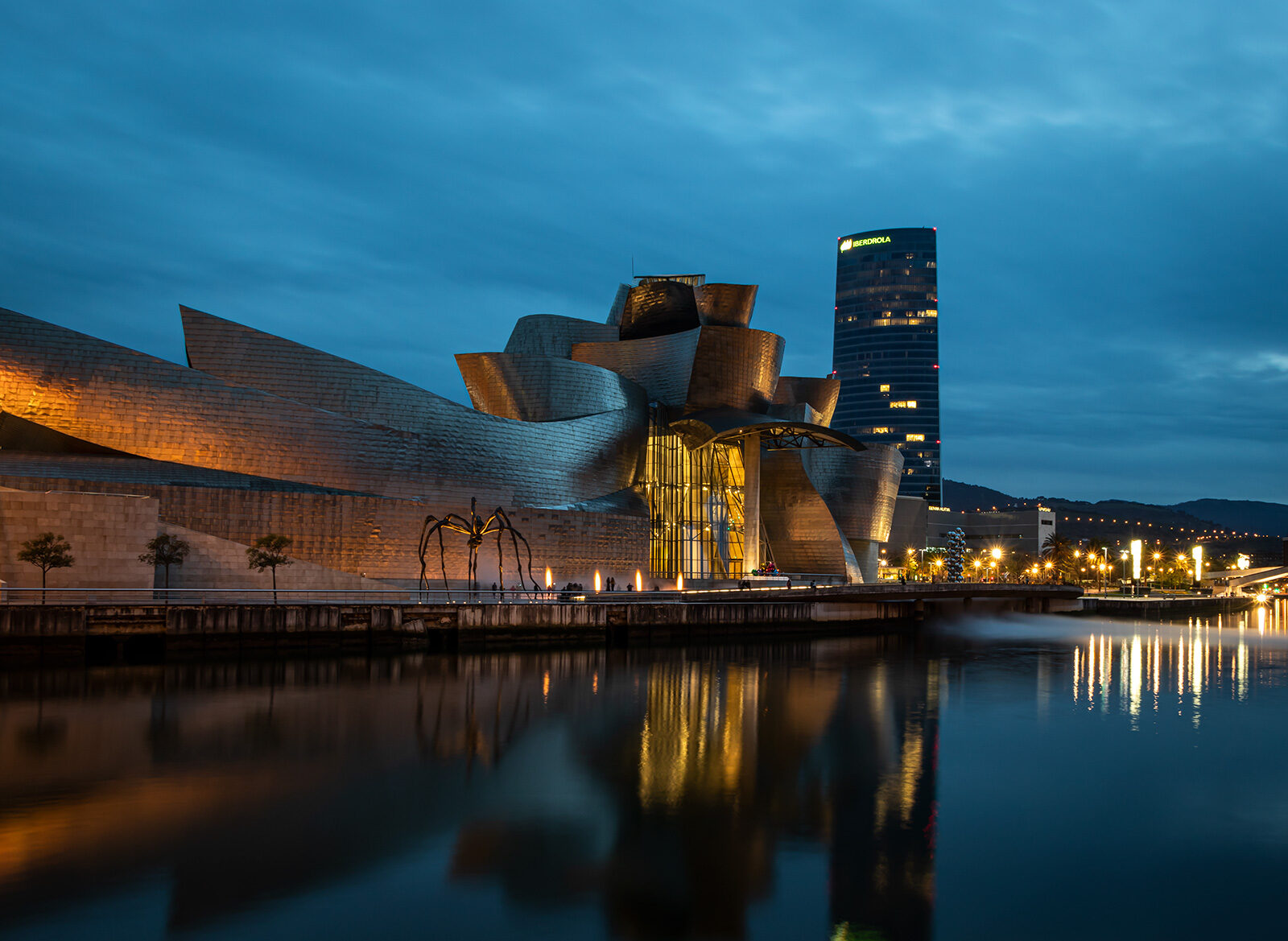
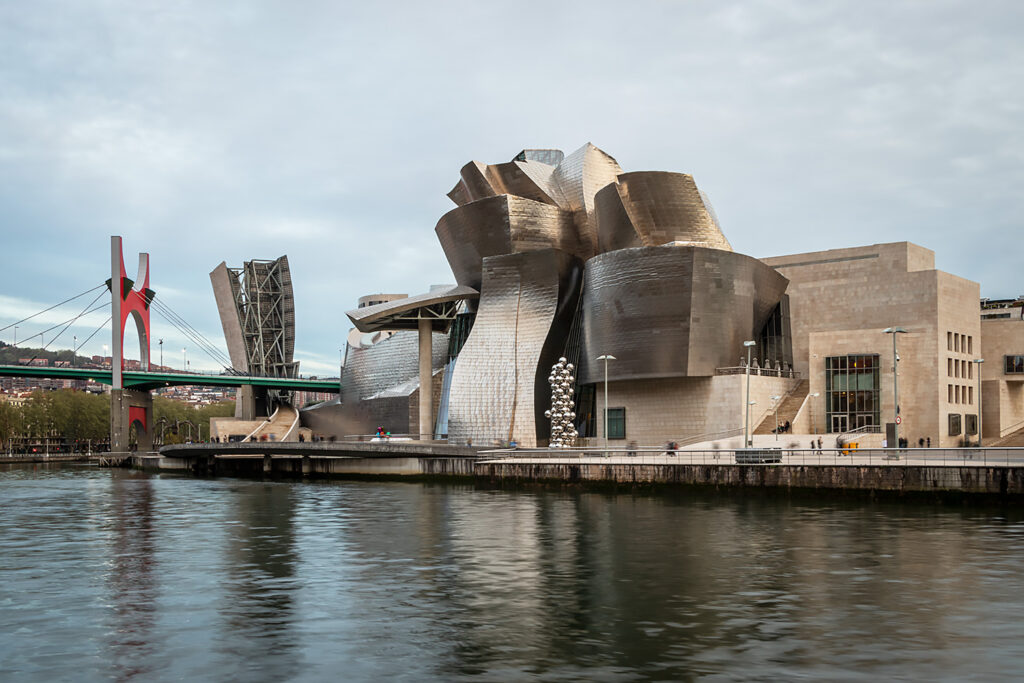
The titanium-clad Guggenheim Museum glittered in the dark, magically reflected in the river. Already there, on the other side of the river, I was sold, and as soon as I checked into the hotel, I ran to shelter from the rain under the red La Salve bridge so I could admire the organic shapes and the play of colours of the titanium plates of the 57-metre-high museum.
I found it hard to detach myself again, and never have I waited so impatiently for a museum to open. The next morning, the Guggenheim Museum was beaming with the sun as I walked over the La Salve bridge towards the museum. Now the titanium plates glittered in a completely different way that was just as fascinating.
Since then I have visited the Guggenheim Museum in Bilbao several times, taking many walks around it, admiring the artworks inside and out, and each time is a new experience. The Guggenheim in Bilbao is constantly changing.
The Canadian-American architect Frank O. Gehry has created the museum with its fish-like shape and 33,000 titanium plates that change expression according to weather and light.
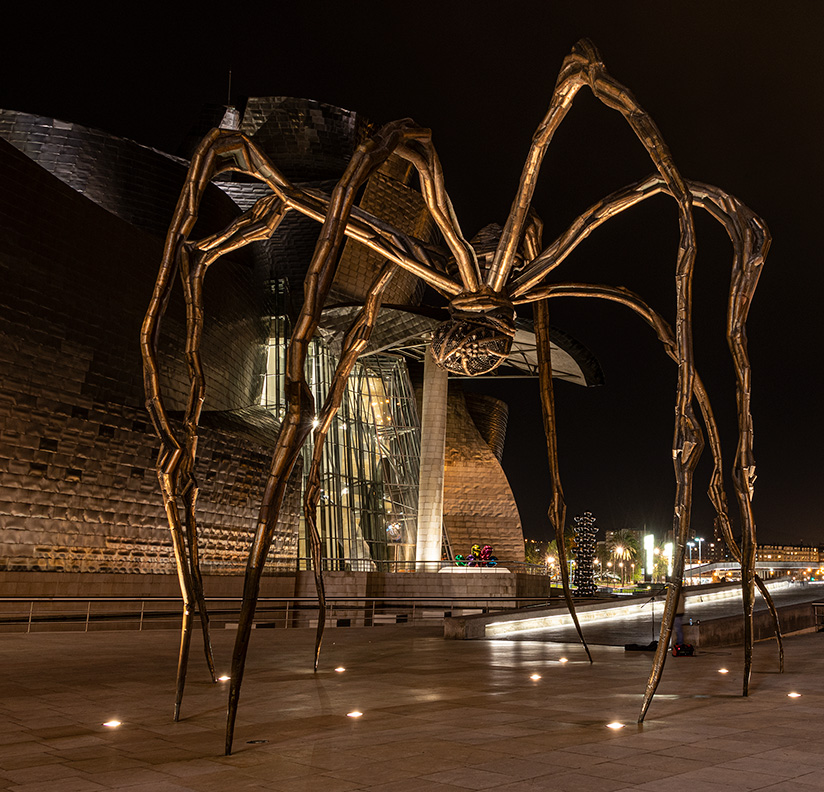 Spider as a protective welcome
Whether you enter the museum from the back or main entrance, the sight is overwhelming enough to take your breath away. Walking along the back of the museum, by the La Salve Bridge, you are greeted by my favorite piece of art. Louise Bourgeois’ giant spider, Mamen, embraces you like a large protective mother animal as you stand under the iron beast’s body and are surrounded by the thin legs.
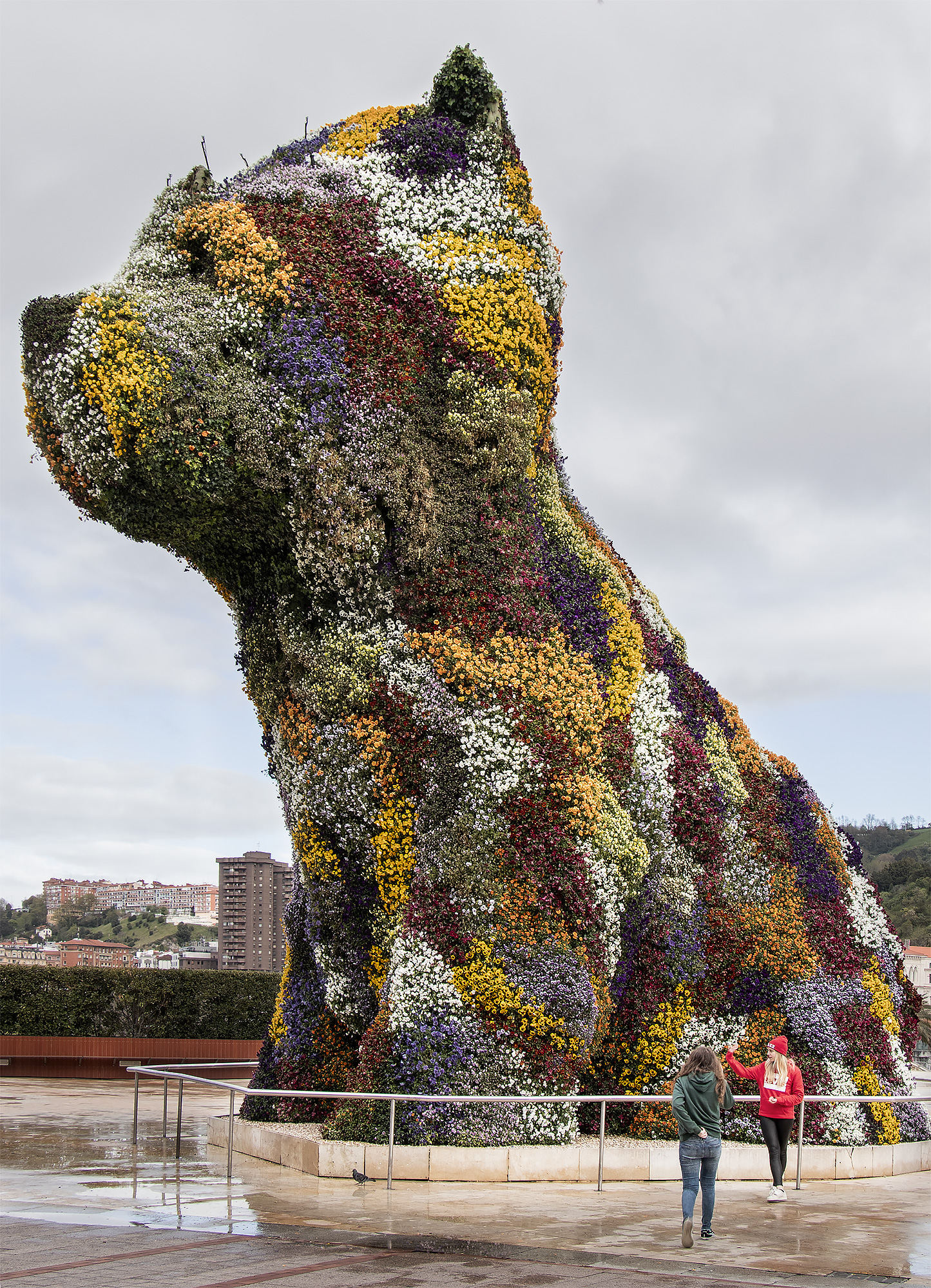 The world’s largest flower sculpture
On the other side, at the museum’s main entrance, Jeff Koons’ 23-meter-tall Puppy, covered with some 60,000 brightly colored flowers, is guarded by the terrier, which Koons says is meant to inspire optimism and instill “confidence and security”.
Outside, you’ll also find Koons’ Tulips, as well as works by artists such as Yves Klein, Eduardo Chillida and Fujiko Nakaya. I suggest you take plenty of time to walk around the 24,000 square meter building and take a close look at how, from all angles, it interacts beautifully with the riverside area.
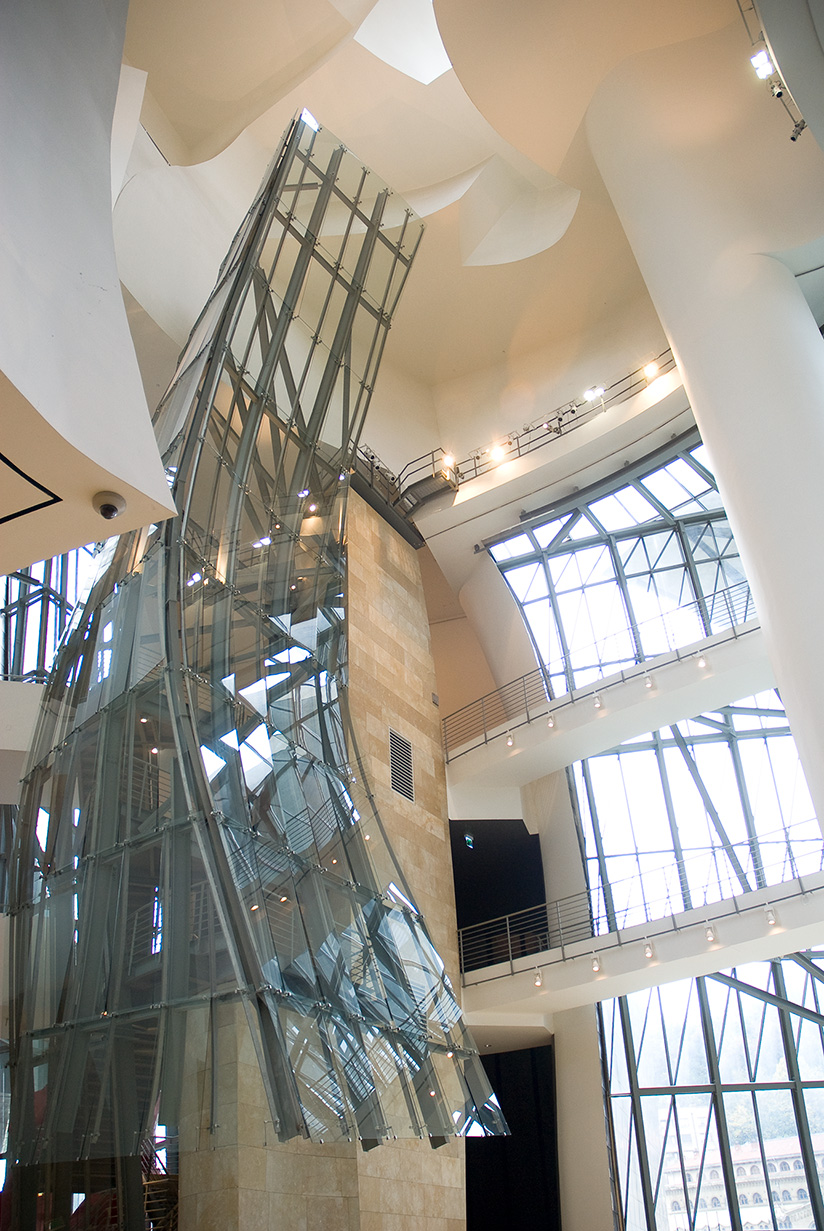
Art galleries and building merge
Inside, a large bright atrium with limestone walls, glass and titanium facades is the heart of the museum, connecting the three floors of which 11,000 square metres are exhibition space. From here, the 20 galleries are accessed via walkways, stairs and glass elevators.
On the ground floor you can look out onto the river, the outside of the building and see how well the interior and exterior of the building blend together. You can also go outside where there is a small platform where you have a view of the art outside and the surroundings.
A beautiful labyrinth of rusty steel plates
The Guggenheim Museum houses only modern art. On the ground floor you’ll find the interesting installation The Matter of Time, which is considered one of the museum’s masterpieces. It was created by the American sculptor Richard Serra.
The installation consists of seven sculptures made of thin, rolled steel plates, which together form a passage that fills the entire 130-metre-long, asymmetrical gallery, the museum’s largest.
As you walk through the passage of sculptures, the shapes change from spirals and ellipses to torsos of different sizes and heights. You can only look up, and you have to go back the way you came in.
The Sierra challenges our claustrophobia, but if you surrender to the shapes and changing colours of the steel plates, the trip is a fantastic experience.
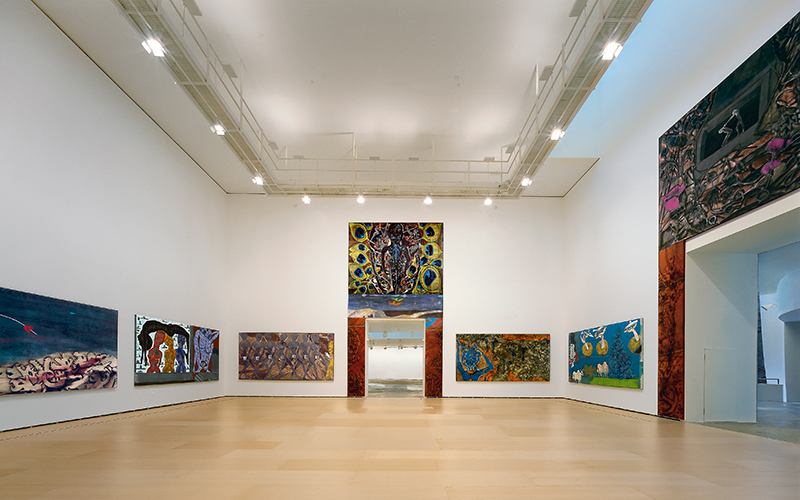
Changing exhibitions of Spanish and international artists
The Guggemheim Museum’s own collection contains around 113 works by 69 artists from around 1950 onwards. Among the most important are the outdoor works.
Despite the modest collection, there is always plenty to explore. The museum displays works from the vast Solomon R. Guggenheim Foundation collection as well as hosting changing exhibitions.
The program of changing exhibitions is varied, and you can experience both local and international artists. In the past, Guggenheim Bilbao has hosted exhibitions by Danish Asger Jorn, Francis Bacon, Yoko Ono, Pablo Picasso, Jeff Koons, Louise Bourgeois and Andy Warhol, among others.
In addition to painting, audiovisual art, photography, sculpture and installations with a focus on sustainability are also part of the changing exhibitions.
Breathing new life into Bilbao
The Guggenheim in Bilbao, funded by the Solomon R. Guggenheim Foundation, was inaugurated in 1997.
It was commissioned by the Basque government, which wanted to modernise Bilbao, which had historically gone from being a renowned port and industrial city to, by the 1980s, a struggling and polluted city with economic problems. The Guggenheim Museum was one of a series of new attractions built to complete that mission.
The museum was strategically built on the formerly vital port and industrial site, which now lay deserted and abandoned. In his choice of materials such as titanium and in the fish-like shape of the museum, Frank Gehry created a building with reference to the area and Bilbao’s history.
Already at the opening, the public flocked, as attracted by the famous architect and his spectacular building as the exhibitions. Since then, the number of visitors has increased so dramatically that it has changed the city in the desired direction.
Bilbao has new hotels, shops, restaurants and a cleaner city with more green spaces and cycle paths, not to mention more cultural attractions. Many other cities around the world are inspired by the “Bilbao effect”.
Show this post on Instagram
Eat well at Bistró Guggenheim Bilbao
The museum houses the Guggenheim Bistró Bilbao, where I recommend having lunch.
The bistro is run by IXO Grupo, which owns several popular restaurants in the Basque Country, including Nerua, which is also located in the museum.
The organically shaped Bistró is uniquely designed by Frank Gehry and features wood paneling, tables and chairs, and large red sofas along the walls. The white paper placemats on the tables are adorned with Frank Gehry’s sketch for the Guggenheim Museum. The atmosphere is relaxed and unpretentious, and the views of the river and architecture are beautiful.
Bistró Guggenheim serves Basque dishes rooted in traditional cuisine, served in simple, avant-garde reinterpretations.
I often eat their tasting menu, which consists of three courses. An important reason I keep coming back is that the chefs really know how to showcase the local ingredients. And everything tastes like more. From the vegetables, which often play a starring role in the healthy dishes, to the freshly caught fish and local meat.
You can choose to create your own menu from the menu, which includes an excellent endives salad with cheese cream and anchovies, octopus, hake with citrus vinaigrette, duck cannelloni (also very good) and Basque cheesecake.
Alternatively, you can choose a menu from the fast food menu. Bistró Guggenheim also has a good wine list with local labels.
If you don’t have time for lunch, you can visit Bistró’s café, which is an extension of the restaurant. Here you can get local beer, pintxos and coffee, which you can enjoy on the terrace in front of the main entrance.
I recommend booking a table in advance at Bistró Guggenheim Bilbao.
Skip the line and buy an entrance ticket to the Guggenheim Museum
Museo Guggenheim de Bilbao, Abandoibarra Etorbidea 2
More travel tips for Bilbao
Find more travel tips for your vacation in the Bilbao big city guide and the guide to Bilbao’s creative neighborhood La Vieja.
If you are looking for a good hotel, I can recommend the Ercilla in Bilbao city centre
Read also the guide to art exhibitions in Spain in 2026, where one of the Guggenheim exhibitions is also mentioned.